


Air conditioning installation in London










System types
Split, multi-split, cassette and ducted systems
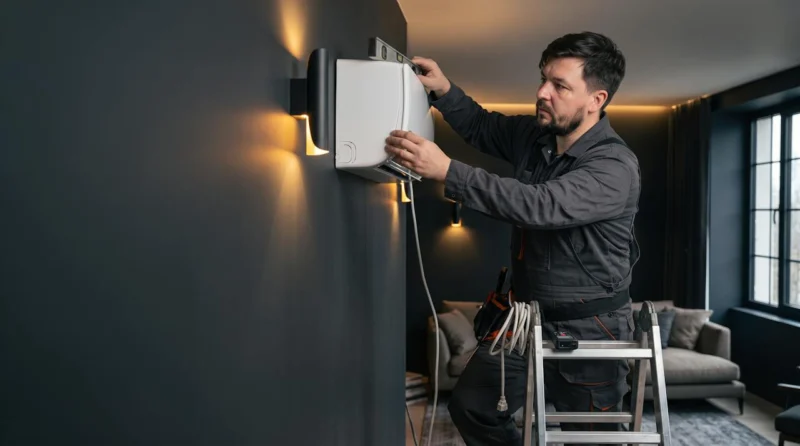
Most air conditioning installation in London for homes and small offices means a split system: one outdoor unit connected by refrigerant pipes to one indoor unit, usually wall-mounted. A multi-split connects several indoor units to a single outdoor unit, which saves wall space outside but means the units share one compressor and one set of pipework. We check what the building can accommodate at the survey and unit sizing stage.
Cassette units sit flush in a suspended ceiling and blow air in several directions, which suits offices and shops. Ducted systems hide the equipment above a ceiling and deliver air through grilles, giving a cleaner look but needing more ceiling void and planning. Floor-standing and portable units exist too, though portable units are less efficient and need a window hose for exhaust air.
Room by room
Which type tends to suit which space
Bedroom
A quiet wall-mounted indoor unit placed away from the bed head to avoid direct airflow.
Home office
A compact wall unit sized for equipment heat as well as the room, since computers add load.
Open-plan living
A larger unit or two smaller ones, positioned so air reaches the whole space.
Shop or office
Ceiling cassettes or ducted units that keep walls and floors clear for customers and staff.
Loft or extension
Heavily glazed or top-floor spaces gain heat quickly and often need extra capacity.
Heating too
Reversible air conditioning for cooling and heating
Most modern split systems are reversible heat pumps, so the same unit that cools in summer can heat in winter. Moving heat is far more efficient than generating it with a direct electric heater, which can lower running costs for a room that is used regularly. It will not replace a central heating system in most London homes, but it can heat an extension, office or bedroom quickly without running the whole system.
When comparing models, look at the seasonal efficiency ratings on the energy label (SEER for cooling, SCOP for heating) rather than only the kilowatt output. Correct sizing matters as much as the rating: an oversized unit cycles on and off and wears faster.
Repair
Signs your air conditioner needs repair
- Blowing air but not cooling the room
- Water dripping inside from the indoor unit
- Ice on the indoor unit or pipework
- Unusual noises, rattling or humming from the outdoor unit
- Unpleasant smells when the unit starts
- An error code on the display or remote
- Tripping the electrical supply when it starts
- Cooling that has gradually weakened over seasons

Repair or replace
Air conditioning repair in London: repair or replace?
Many faults are simple: a blocked filter, a blocked condensate drain, a failed sensor or a tripped supply. Others point to a refrigerant leak, which should be traced and repaired before topping up, since adding gas to a leaking system only delays the problem. Only a suitably qualified engineer should open the refrigerant circuit. If your system has stopped working, book a visit and we can diagnose the fault first and explain whether repair makes sense.
As a rule of thumb, a very old system, one using an obsolete refrigerant or one that needs a new compressor may be better replaced than repaired. Newer systems use refrigerants with a lower global warming potential, and replacement can improve efficiency. A survey will show whether your existing pipework and outdoor position can be reused.
F-Gas rules
F-Gas regulations and refrigerant handling
Air conditioners contain fluorinated greenhouse gases, and handling them is regulated by the UK F-Gas Regulations. By law, anyone installing, servicing, repairing or recovering refrigerant from this equipment must hold the appropriate F-gas qualification, and the company employing them must be certified. Deliberately venting refrigerant into the air is illegal, and leaks must be repaired without undue delay. You can ask any contractor to show their F-gas company certificate and engineer qualification.
Larger systems carry duties for the equipment owner as well, including leak checks at set intervals and records of refrigerant added or recovered, with the frequency depending on the quantity of gas. Most single-room systems fall below those thresholds, but the same handling rules still apply. The system is also pressure and leak tested during commissioning and handover.
Permission
Planning, listed buildings and leasehold consent
Whether an outdoor unit needs planning permission depends on the property and the council, so check before ordering. Houses, flats, conservation areas and listed buildings are treated differently, and units on a front elevation or visible from the street attract more scrutiny. In a listed building, fixing pipework or a unit to the fabric can require listed building consent as well, and in a conservation area the council may want a discreet position. Always ask the local planning authority first.
If you are a leaseholder, the lease usually restricts alterations to the exterior or structure, so you will probably need written consent from the freeholder or managing agent before drilling through walls or fixing equipment to the building. Tenants need their landlord's consent. Commercial tenants should check their lease for rules on alterations and fixing plant. Get consent in writing before the survey is booked so positions can be planned within those limits.
Noise
Noise from air conditioning and neighbours
Noise is the most common complaint, both indoors and from neighbours. Manufacturers publish sound levels for indoor and outdoor units in decibels, and lower numbers mean quieter operation. Outdoor placement matters as much as the model: avoid fixing units to thin walls, close to bedroom windows or in narrow courtyards where sound bounces. Anti-vibration mounts reduce transmitted noise.
Councils can act against noise that amounts to a statutory nuisance, and noise can also breach lease terms or planning conditions. Many units have a quiet or night mode that lowers fan speed and compressor output. Your outdoor unit mounting position is therefore worth discussing before work starts, with your neighbours too.
Preparation
How to prepare for installation day
Agree positions
Decide where the indoor and outdoor units will go and where pipes will run.
Clear access
Move furniture and valuables away from the walls where work is happening.
Confirm consents
Have landlord, freeholder or council permission in hand before work starts.
Check the supply
Make sure the electricians know where the consumer unit is, and whether a dedicated circuit is available.
Plan for noise and dust
Coring through a wall is noisy, so warn neighbours and expect some dust.
Running costs
What affects the cost of air conditioning
Price depends on the number of rooms, the type and capacity of unit, how far the pipes run, whether the outdoor unit goes on a wall, bracket or flat roof, access for equipment, and whether the electrical supply needs upgrading. A dedicated electrical connection is part of most installations. Our pricing page shows our rates, and larger jobs start with a free survey and written estimate.
Quotes are easiest to compare when each states the unit capacity, the pipe run, who handles the electrical work and what is included in commissioning. A very cheap quote often leaves out condensate drainage, making good or electrical work.
Aftercare
Looking after your system once it is installed
Clean or replace filters as the maker advises, often every few weeks in heavy use, keep the outdoor unit clear of leaves, boxes and debris, and do not cover it. Use the remote's dry or fan modes to reduce humidity or move air without cooling.
An annual check is sensible, particularly for offices and commercial units, where a failure in a heatwave is more disruptive. A service cleans coils, checks electrical connections, tests for leaks and makes sure the condensate drain installed under pipework and drainage is still running clear.
Local pages
We work across every London borough
See the boroughs we cover, the postcodes in each one and the jobs we are called to most locally.

Air conditioning installation in London, start to finish
Plumbery installs wall-mounted air conditioning for homes and offices across London. One team surveys the room, fits the indoor and outdoor units, runs the pipework and condensate drain, makes the electrical connection and commissions the system, so you deal with one company from the first visit to handover.
Every stage has its own page, so you can see exactly what is done and in what order:
How to choose the right air conditioning unit
The right unit depends on the size and height of the room, how much sun it gets, how well it is insulated and how much heat people and equipment add. A unit that is too small never reaches the temperature you set. One that is too large cools quickly, then switches off before it has removed enough moisture, so the room feels clammy. We check all of this at the air conditioning survey and recommend a capacity from the measurements, not from a guess.
Air conditioning for flats, offices and listed buildings
Flats and leasehold properties may need consent from the freeholder before an outdoor unit goes on the wall, and conservation areas or listed buildings can have rules about the outside of the property. We flag these at the survey so nothing holds up the installation. For offices we work 8am to 10pm, Monday to Saturday, so the work can be planned around your opening hours. Our rates are published by time band on the pricing page.
Air conditioning prices in London
These are guide prices including VAT for wall-mounted systems in London. Call-outs and fault finding are charged at the hourly rate, and the survey fixes the exact installation price before any work starts. The full list is on the air conditioning price list.
| Work | Guide price inc VAT |
|---|---|
| Single-room split system, supplied and fitted | £1,800 – £2,600 |
| Multi-split system, 2 rooms | £2,800 – £4,500 |
| Multi-split system, 3 rooms | £3,200 – £5,800 |
| Multi-split system, 4 rooms | £4,500 – £7,000 |
| Installation only, unit supplied by you | £500 – £1,200 |
| Annual service, one split system | £90 – £150 |
| Refrigerant top-up (re-gas) | £150 – £350 |
| Leak detection, repair and pressure test | £250 – £600 |
| Call-out and fault diagnosis, first hour | from £102 inc VAT (business: £85 + VAT) |
Air conditioning installation questions
How much does air conditioning installation cost in London?
A single-room wall-mounted split system typically costs £1,800 to £2,600 supplied and fitted in London. A multi-split system for two to four rooms is typically £2,800 to £7,000. These are guide prices including VAT: the survey fixes the exact figure before any work starts.
How much does an air conditioning service or re-gas cost?
An annual service is typically £90 to £150 for one split system. A refrigerant top-up (re-gas) is typically £150 to £350 including the refrigerant. If the system has lost refrigerant we find and repair the leak first, which is typically £250 to £600. Call-outs and fault finding are charged at our hourly rate, from £102 inc VAT (business: £85 + VAT) for the first hour.
How long does an air conditioning installation take?
It depends on the system and the property. The survey settles the pipe route, the outdoor unit position and the electrical supply, and we give you a realistic timescale from that.
Do you do the electrical work as well?
Yes. Refrigeration and electrical work are both done by our own team, so the dedicated supply, isolator and interconnecting cable are wired and tested as part of the same installation.
Do I need permission to install air conditioning?
Leasehold flats may need consent from the freeholder or management company, and conservation areas and listed buildings can have rules about outdoor units. We tell you what to check at the survey, before the installation is booked.
Which areas of London do you cover?
We cover Greater London, everywhere inside the M25, and we work 8am to 10pm, Monday to Saturday.
What happens when the installation is finished?
We commission the system with a vacuum, leak check, refrigerant charge and full test, then walk you through the controls and hand over the paperwork.
Published rates
Air conditioning hourly rates in London
You pay a first-hour rate, then a lower rate for each extra half hour. The rate depends on the day and time of the visit.
| Air conditioning | Mon–Fri 8am–6pm | Mon–Fri 6pm–10pm | Saturday 8am–6pm | Sunday 8am–6pm |
|---|---|---|---|---|
| First hour | £102Business: £85 + VAT | £105.60Business: £88 + VAT | £105.60Business: £88 + VAT | £117.60Business: £98 + VAT |
| Each extra half hour | £50.40Business: £42 + VAT | £54Business: £45 + VAT | £60Business: £50 + VAT | £62.40Business: £52 + VAT |
| Daily rate | £594Business: £495 + VAT | — | — | — |
Prices include VAT at 20%. Offices and companies: the business rate is shown + VAT. Rates apply to jobs inside the M25. Minimum charges apply. Materials are charged in addition to labour. See the full rate card.
Extra If we need to go and buy materials, travel and shopping time is charged at £57.60 per hour inc VAT (business: £48 + VAT). The materials themselves are added at cost.
Plumbers, gas engineers and electricians in every London borough
We attend jobs in all 32 London boroughs and the City of London, and anywhere inside the M25. If you are unsure whether we cover your postcode, call 07353 373753.
- Barking and Dagenham
- Barnet
- Bexley
- Brent
- Bromley
- Camden
- City of London
- Croydon
- Ealing
- Enfield
- Greenwich
- Hackney
- Hammersmith and Fulham
- Haringey
- Harrow
- Havering
- Hillingdon
- Hounslow
- Islington
- Kensington and Chelsea
- Kingston upon Thames
- Lambeth
- Lewisham
- Merton
- Newham
- Redbridge
- Richmond upon Thames
- Southwark
- Sutton
- Tower Hamlets
- Waltham Forest
- Wandsworth
- Westminster
Why Plumbery
Qualified, insured and upfront about price
Every engineer we send is registered or qualified for the trade they work in, and you can check the details before anyone starts.
- Fully insuredEvery job is covered by our insurance.
- Rates published in advanceOur hourly rates are on the pricing page. Nothing starts until you agree the rate.
- Paperwork includedGas safety certificates and electrical records are provided on completion.
- Registered companyPlumbery Ltd, company no. 11677583, registered in England and Wales.